-
-
Project ManagementQuality ManagementAgile and ScrumCyber SecurityBusiness ManagementBig DataCloud ComputingDigital Marketing
Boost efficiency using data-driven methods.
The Lean Six Sigma Green Belt (LSSGB) program is designed for professionals who want to gain a strong foundation in process improvement and operational excellence. This certification equips participants with the skills to analyze processes, identify inefficiencies, reduce defects, and implement data-driven solutions.The course covers the full DMAIC framework—Define, Measure, Analyze, Improve, Control—along with practical tools such as process mapping, root cause analysis, 5S, Kaizen, and basic statistical analysis. Participants will learn to lead small-to-medium improvement projects, support cross-functional teams, and contribute measurable business value.
Comprehensive training in Lean & Six Sigma fundamentals
Strong foundation in DMAIC methodology
Introduction to statistical analysis using Minitab/Excel
Ability to lead small to medium improvement projects
Focus on reducing waste, defects, and process variation
Globally recognized certification for career advancement
Process Improvement
DMAIC Methodology
Lean Tools – 5S, Kaizen, Value Stream Mapping
Problem Solving & Decision Making
Control & Sustain Improvements
Team Collaboration & Communication

Get dedicated assistance for your team
What are the prerequisites for LSSGB Training?
Who Are the Ideal Participants for Tutorial Consulting? LSSGB Training?

Lean Six Sigma Green Belt (LSSGB) certification validates your ability to apply Lean Six Sigma tools and DMAIC methodology to improve processes and drive measurable business results.
The certification can be offered by globally recognized organizations such as ASQ, IASSC, and authorized training providers.
Typically, the exam is multiple-choice, online or proctored, with 100–150 questions, covering all phases of DMAIC, Lean tools, and basic statistics.
Most exams range from 2 to 4 hours, depending on the certifying body.
While prior Lean or Six Sigma knowledge is helpful, there are no mandatory prerequisites for most Green Belt exams. Some programs recommend 1–2 years of professional experience.
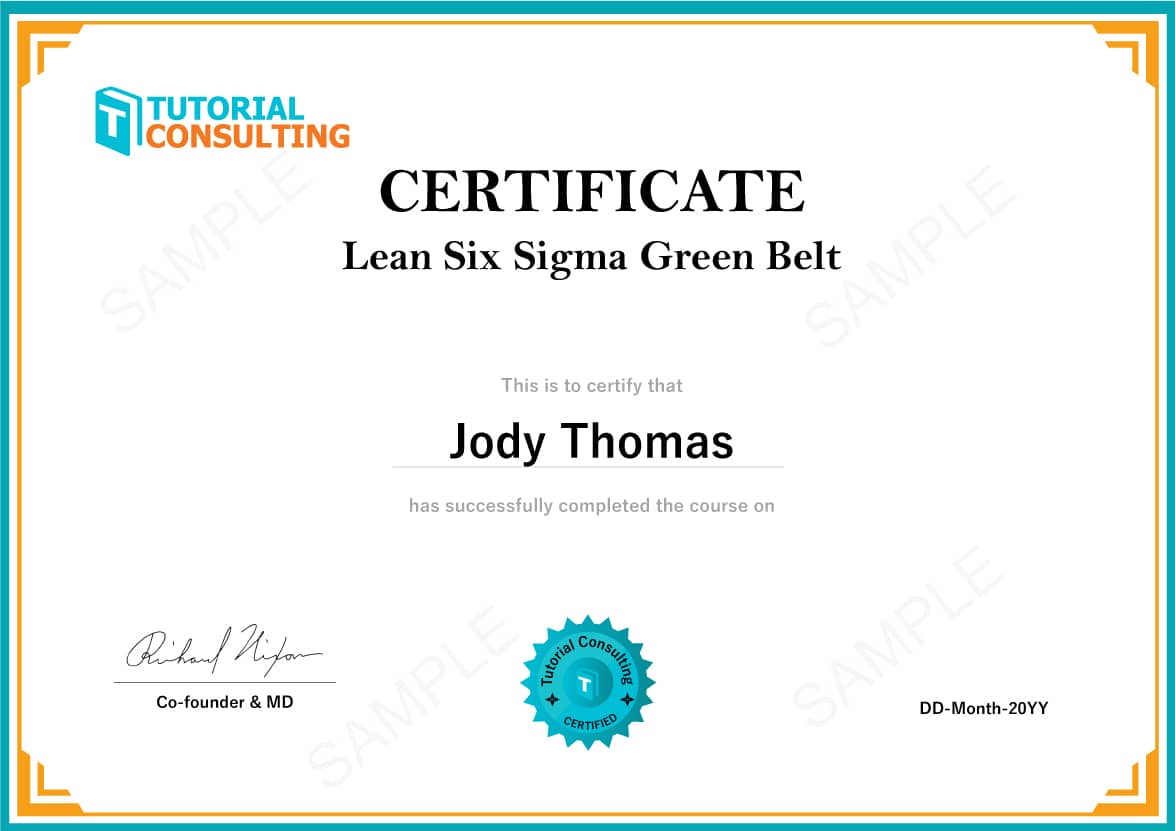
After successfully passing the exam (and sometimes completing a project), you receive a globally recognized LSSGB certificate.
Many certifications are valid for 3 years, after which renewal may be required based on the certifying body.

“Class was somewhat dry for the first part but understandably so due to the material. Once we moved t...” View More


“As an instructor, it's nice to have great communications from the home office as to what to expect a...” View More

“Great class! It was a ton of information to take in, but the instructor made it easy to follow and p...” View More

A Six Sigma Green Belt is a individual who has been trained in Six Sigma methodology and can lead quality improvement projects in an organization.
You must have a computer or a laptop and a well-connected internet connection to attend the Lean Six Sigma Green Belt training sessions. For several courses, you will also need access to tools like Minitab or any other statistical software.
Six Sigma certified professionals are designated as Process Improvement Specialists, Quality Analysts, Operations Managers, Project Managers, and Data Analysts.
General Electric, Amazon, 3M, Honeywell, TATA Consultancy Services, Accenture, etc., are some of the top companies that hire Six Sigma experts.
The average salary of a Six Sigma green belt professional is 95000$ in the US.
No. Most Six Sigma green belt courses offer taped sessions of live classes so that you can cover missed content at your own pace.
Upskilling is of utmost significance in the current fast-paced business environment. The Green Belt Training is a very inclusive program that leaves participants with comprehensive Lean Six Sigma process knowledge and the skills to lead process improvement efforts that deliver bottom-line results. Green Belt Program: THE Green Belt program is a must for anyone interested in making process improvement their career or to lead process improvement initiative.

Skill you’ll gain: Cost management, Project cost estimating
Skill you’ll gain: Advanced DMAIC Mastery, Risk Management
Skill you’ll gain: Project Management Fundamentals, Risk & Quality Management
Copyright @ 2018-2026 Tutorial Consulting. All Rights Reserved.
Avail Group Discount